Early Iconography of Baby Moses

Early Iconography of Baby Moses
"Look at the baby crying and tightly grasping the young woman's finger. That is Moses. Do you know who this beautiful woman is? She is an Egyptian princess, the daughter of Pharaoh."
Baby Moses frequently appears as an iconographic subject in the Renaissance and post-Renaissance periods. One of the reasons for this—the obvious one, of course—is the popularity of scenes from Old Testament stories. However, I believe it's undeniable that the narrative of Baby Moses has a unique appeal of its own. This moment, depicted while he was still just a baby, before anyone knew he would become a prophet, has long been a subject of interest for artists. Remarkably, one of its earliest extant examples is a mural painted on the wall of the oldest surviving synagogue, located in Dura-Europos, Syria, dating from between 244 and 255 CE (or AD).
Dura-Europos Synagogue
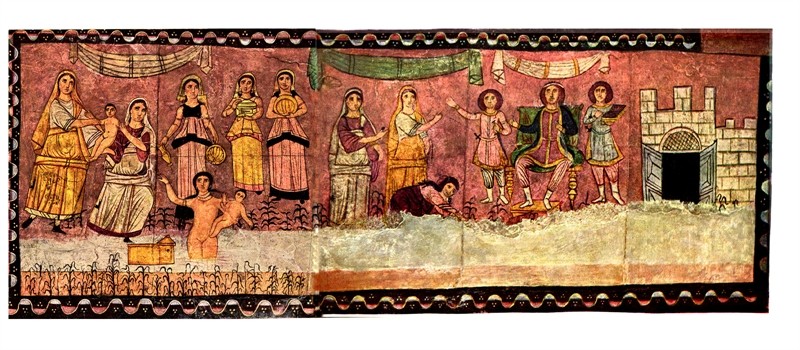
(Dura-Europos Synagogue, National Museum of Syria, Damascus, 244 CE (or AD))
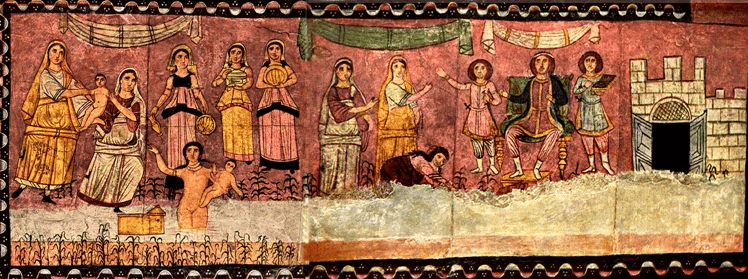
The panel is situated on the west wall and constitutes the largest section of the northern half of the bottommost Section C, which is located to the right of the Torah niche. On the right side, there is a depiction of a fortress gate and the adjacent city wall. The walls are constructed with stone blocks, and the gray doors of the passage, whose interior is rendered dark, open outwards.
The King is seated on a throne, accompanied by attendants on both sides. He wears a long-sleeved blue mantle over wide, pink trousers typical of the Persians, a yellow belt, and an embellished, striped tunic underneath. He has white boots on his feet, which rest on a yellow footstool. His face is framed by a dense mass of brown, curly hair, and he wears a yellow crown. With his left hand, he holds the hilt of a long sword, while his right hand is extended towards the visitors. The King's throne is draped with green fabric.
The attendants are dressed in long-sleeved tunics, trousers, and white boots. The one on the right is writing something on a diptych held in his hand, while the other is presumably making a gesture of acceptance with his right arm and holding the hilt of his sword with his left hand. Two women are approaching the King’s presence, extending their right arms towards him. They are dressed in elbow-length, long-sleeved chitons, with a long piece of fabric wrapped around their waists, and a third garment featuring vertical folds that extend from just below their hips down to their ankles.
On the left side, slightly raised from the ground level, three women are depicted frontally, carrying ornamental objects such as a golden pitcher, a rectangular ivory box with a pyramidal lid, and two fluted gold bowls. They are clad in high-girdled chitons with embroidered edges and full skirts, where the folds gently hang down, and they wear veils on their heads. The artist has applied black borders to both parts of the pink garment, and pink borders to the yellow garment of the central figure. In front of the group, a naked woman is standing in the river, carrying a naked infant on her left arm. The extremely expensive jewelry she wears, such as the two pearl necklaces, indicates that she belongs to an elite class. Aside from her jewelry, her body, which remains above the water, is shown frontally and is completely nude.
The second scene, which is closely integrated with the first, likely depicts Moses' mother placing Moses in the ark, suggested by her kneeling at the riverbank and the position of her arms, as narrated in Exodus 2:3. If this interpretation is correct, the artist has illustrated Moses' survival despite all of Pharaoh's efforts. The naked princess, accompanied by her attendants in the subsequent scene, is the daughter of Pharaoh and is represented as finding Baby Moses and saving him from drowning. The artist has condensed the later scene where the princess gives Baby Moses to his sister, who is depicted in brown attire, and Miriam (Mariam) then returns him to his mother, who is shown in yellow attire, for nursing. The most significant debate regarding this panel centers on the nude depiction of the princess. This visual must have appeared as an obscene image, even to a Hellenistic Jew living in Eastern Syria, especially considering that the depiction of female nudity was generally considered unacceptable in Judaism. Goodenough, who was the first to attempt an interpretation of this iconographic exception, pointed out that the posture of Pharaoh's daughter resembles the depictions of ancient goddesses, particularly Anahita in the Iranian pantheon. According to Goodenough's explanations, the artist consciously drew a parallel between Pharaoh's daughter and Anahita/Aphrodite in this scene.
The Iconography of Baby Moses in Art History, with Further Examples
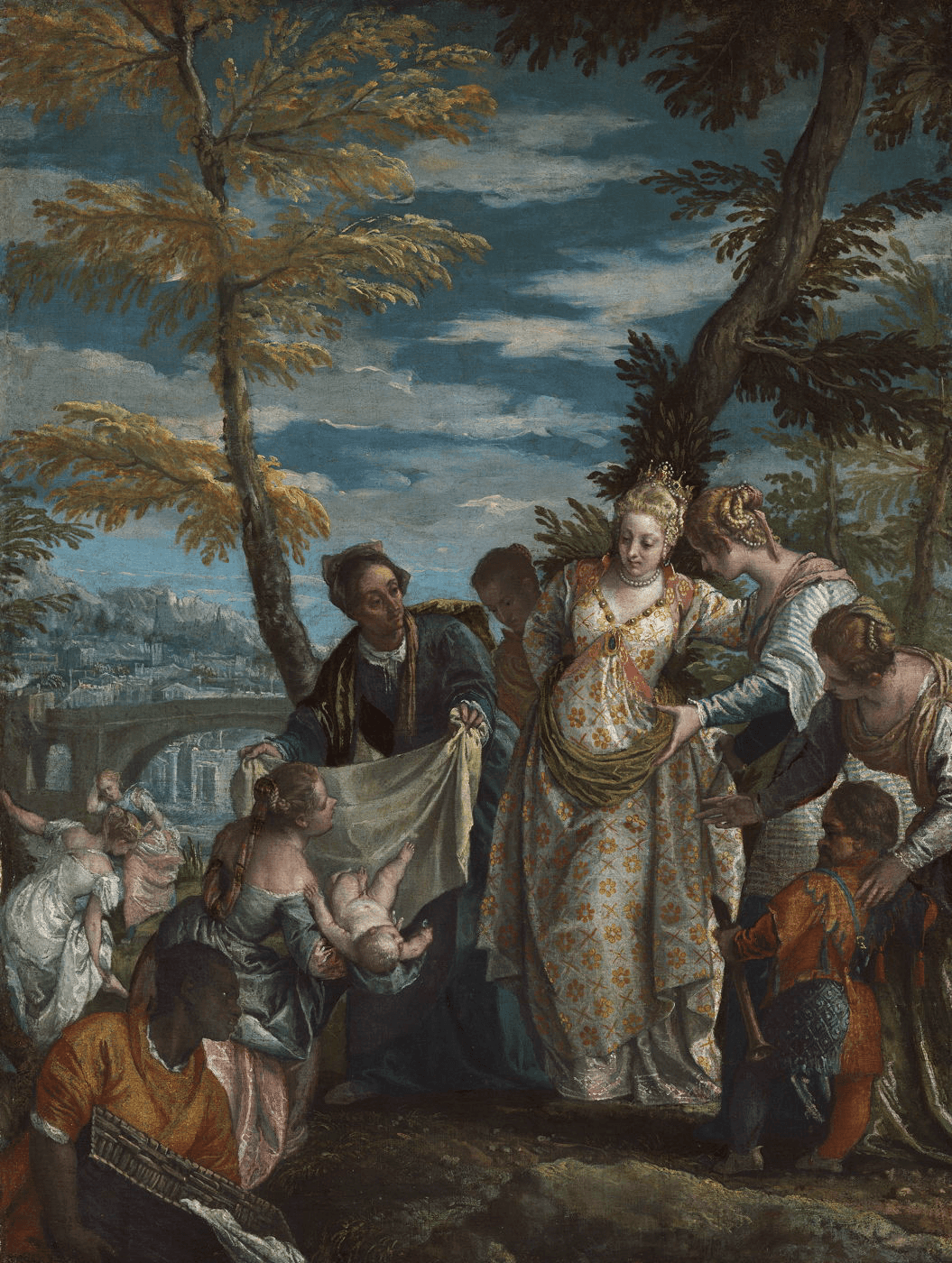
(Paolo Veronese (1528–1588), The Finding of Moses (c 1581-82), oil on canvas, 58 x 44.5 cm, National Gallery of Art, Washington, DC)
The familiar scene is depicted in front of classical Italianate architecture of the period, with figures dressed in contemporary garments. Moses is being held by an African servant, while another member of the princess's retinue presents the infant to the princess for her closer inspection, and then to an elderly nurse to be wrapped and cared for. To the right of Pharaoh's daughter, Miriam is offering to procure someone to nurse the baby.
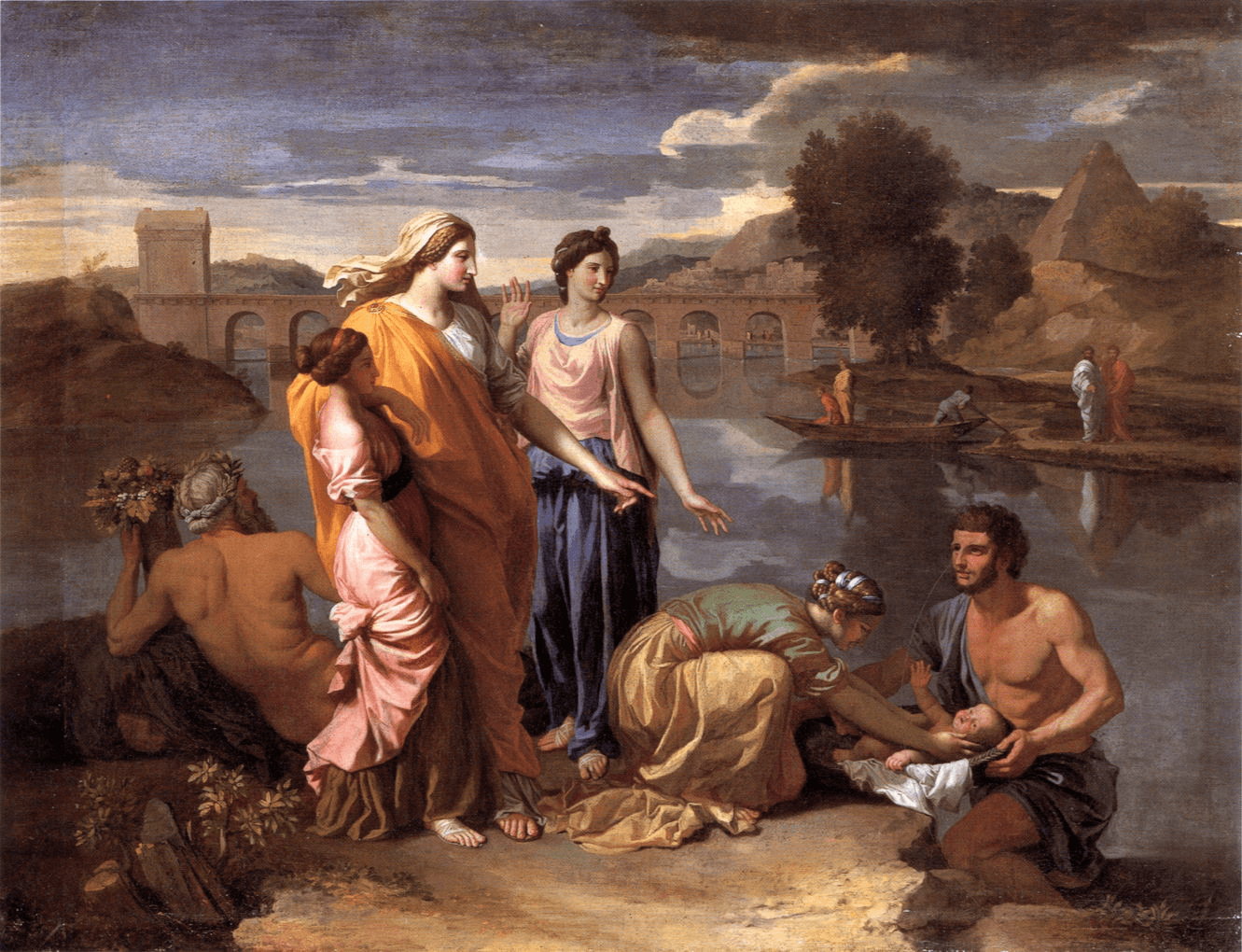
(Nicolas Poussin (1594–1665), Moses Saved from the River (1638), oil on canvas, 93.5 x 121 cm, Musée du Louvre, Paris)
Poussin, however, introduces a novel interpretation of the narrative, presenting a version in which the assistant who recovers the infant is male. This distinct choice contributes significantly to the work's unique character. Within the idealized landscape positioned behind the figures, the composition includes a stately bridge, a pyramid—which subtly alludes to the original locale of the story—and a traditional river god whose back is oriented away from the spectator.
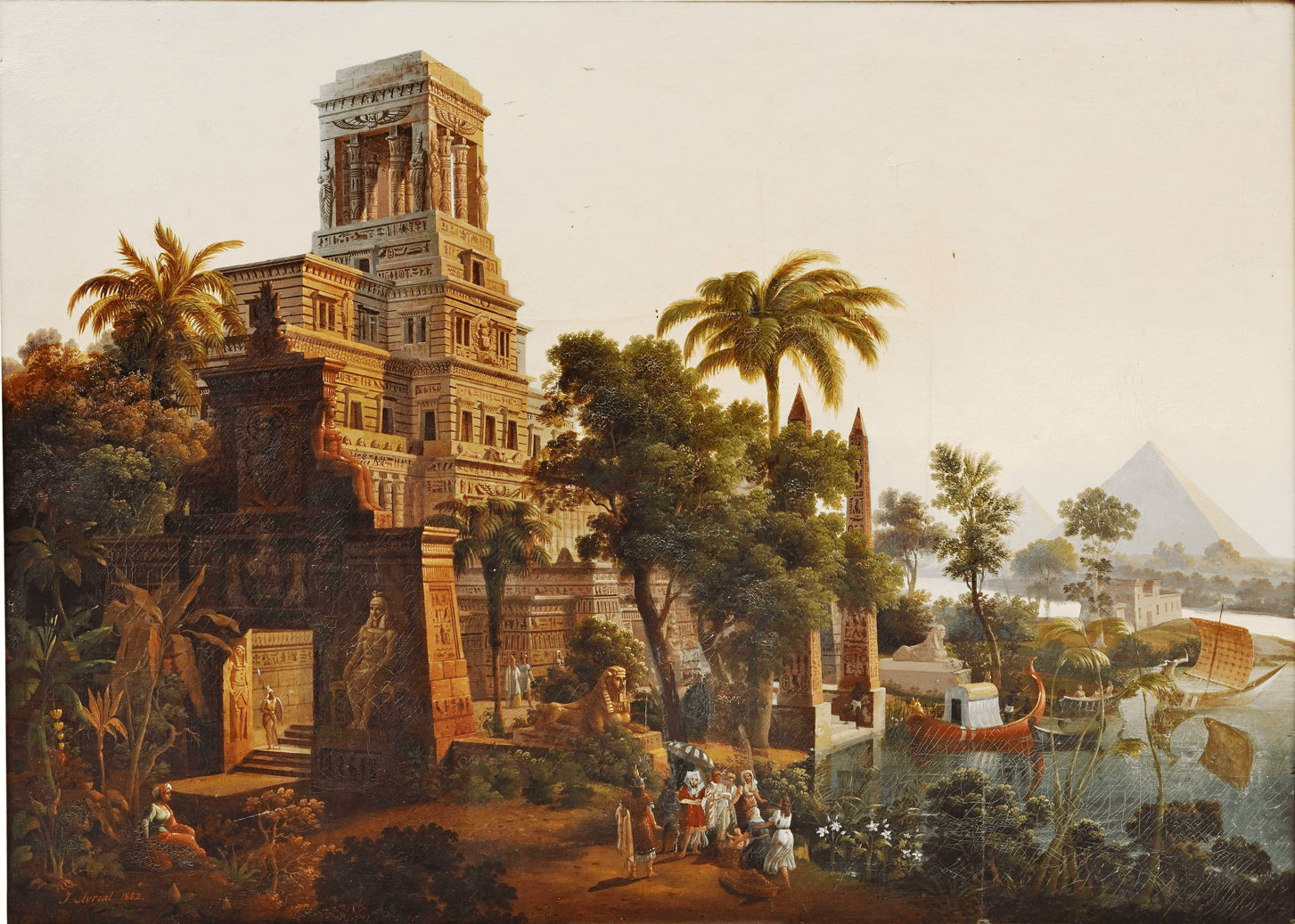
(José María Avrial y Flores (1807–1891), Pharaoh’s Daughter Rescuing Moses from the Nile (1862), oil on canvas, 70 x 96 cm, Museo Nacional del Prado, Madrid, Spain)
In this work, dated 1862, the story is conveyed through small figures seemingly overwhelmed by the colossal architecture. The artist once again presents a distinctive narrative by including the scene where Moses' sister, Miriam, observes the presentation of her infant brother to Pharaoh's daughter from the lower-left corner.
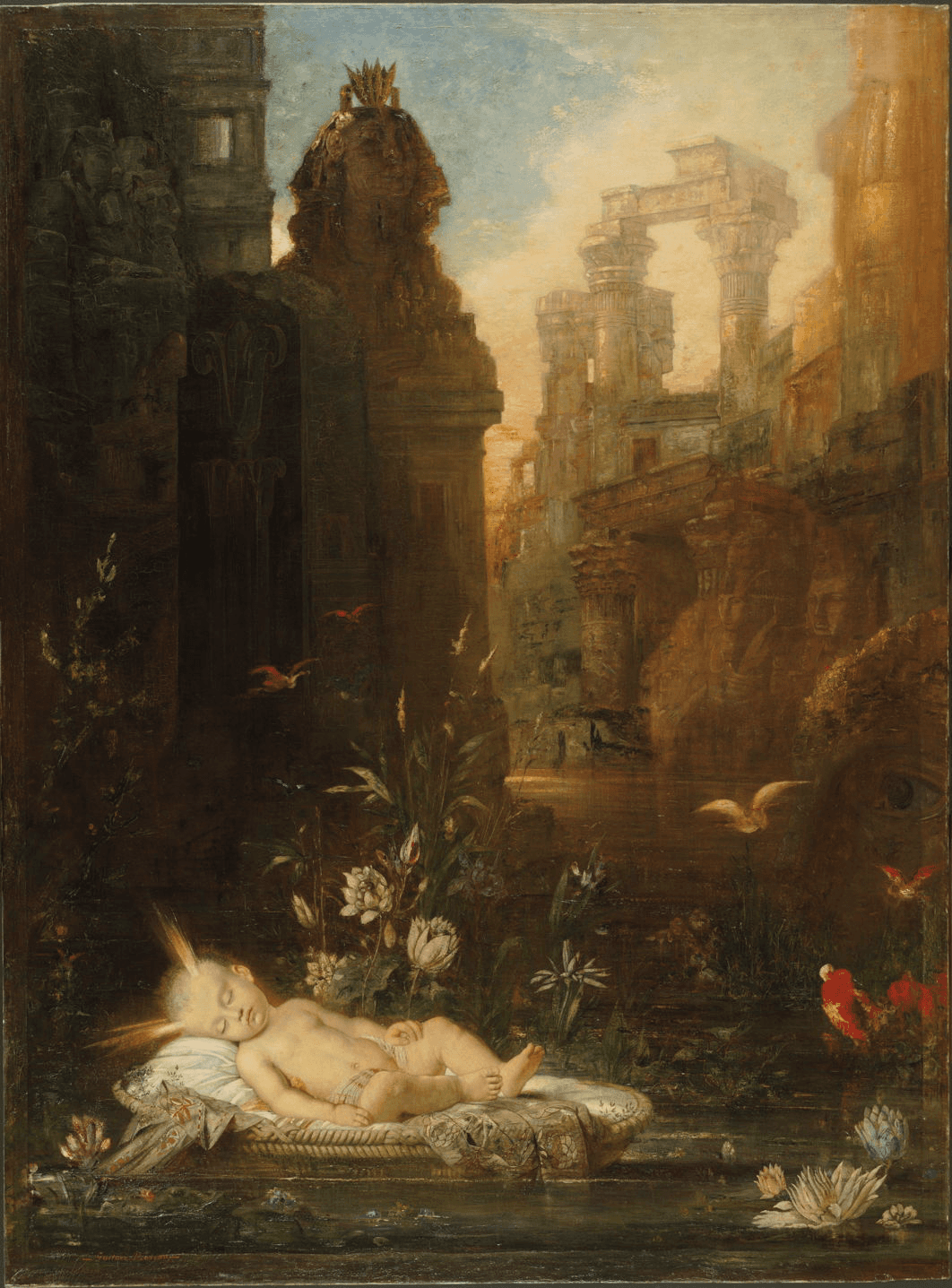
(Gustave Moreau (1826–1898), Moïse Exposé sur le Nil (The Infant Moses) (c 1876-78), oil on canvas, 185 x 136.2 cm, Harvard Art Museums/Fogg Museum (Bequest of Grenville L. Winthrop), Cambridge, MA. Courtesy of Harvard Art Museums)
Gustave Moreau selected this narrative as part of a three-painting cycle focusing on the ages of humanity, and the work was subsequently exhibited at the Exposition Universelle in 1878. Moïse Exposé sur le Nil (The Infant Moses), painted between approximately 1876 and 1878, is a striking depiction of the baby Moses sleeping before his discovery among the reeds. Moreau chose to portray Moses—who, according to the Old Testament, was destined to bring new enlightenment to a decaying Egypt—surrounded by exotic flowers and birds. Moreover, this very selection also articulated Moreau's hope for the French nation. Significantly, Moreau did not illustrate the traditional and widely popular moment of the baby's discovery in the reeds, but rather depicted this static scene that immediately precedes it.
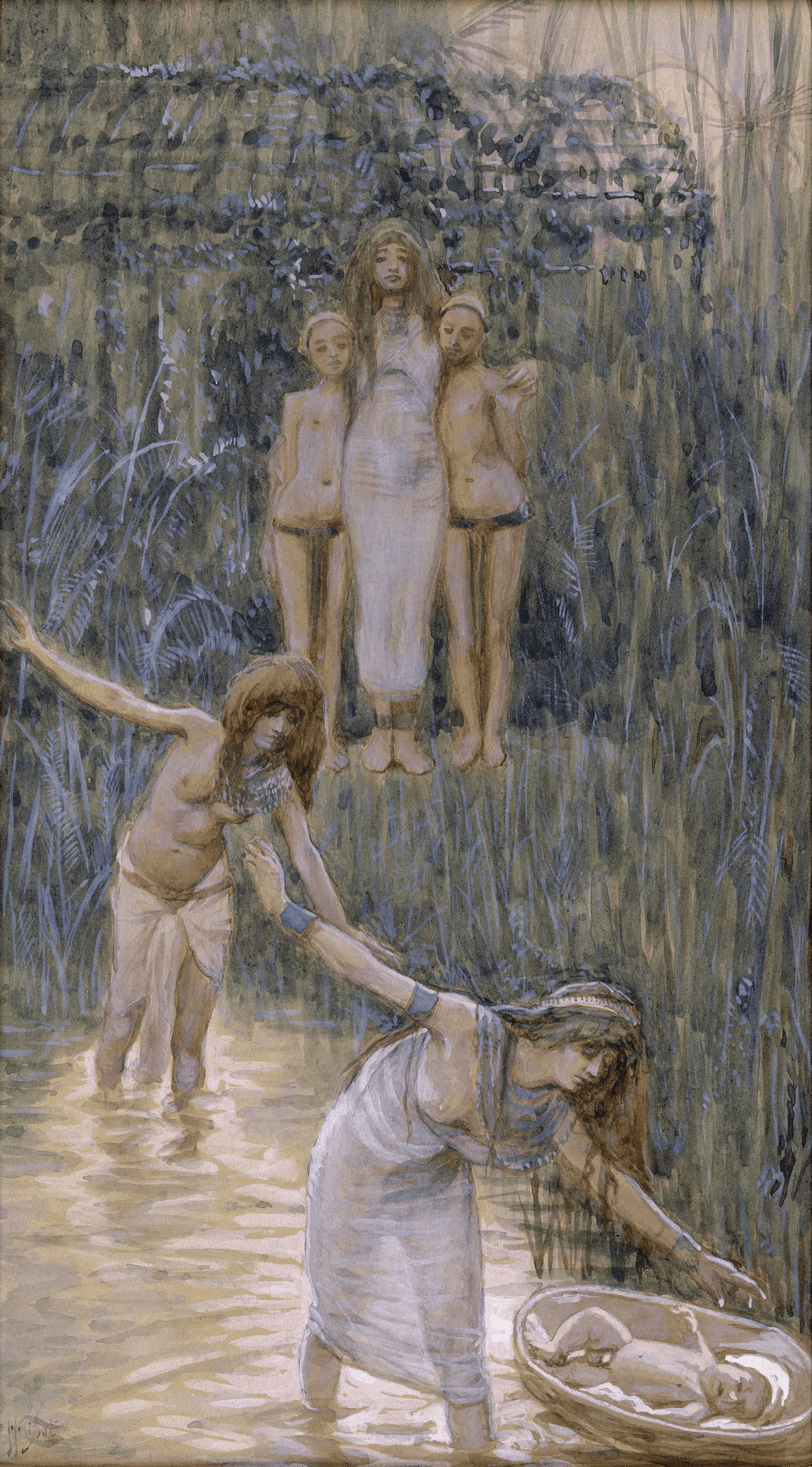
(James Tissot (1836–1902), Moses Laid Amid the Flags (c 1896-1902), gouache on board, 25.2 x 12.4 cm, The Jewish Museum, Mew York, NY)
Tissot, conversely, chose to narrate the familiar story using his own modern illustration style. Consequently, the Iconography of Baby Moses found its place within the art of painting, explored through various perspectives.
References
■ AL RIHAWI, Nivine. (2020). Wall Paintings of Monotheistic Religions in Dura-Europos: Comparison of Text and Wall Paintings. (Master's Thesis). Bursa.
■ The Eclectic Light Company. (2019, December 28). Foundling: Paintings of Moses in the bulrushes. Retrieved from https://eclecticlight.co/2019/12/28/foundling-paintings-of-moses-in-the-bulrushes/